Effective Altruism in Jewish Thought
By Rabbi Dr Glenn Y. Bezalel, for the Jewish Ethics Project
Glenn Y. Bezalel is Deputy Head (Academic) at City of London School, where he teaches Religion & Philosophy. A graduate of Yeshivot Kerem B’Yavneh and Har Etzion (Gush), he holds Semicha from Eretz Hemdah. He also has a PhD in conspiracy theories from the University of Cambridge, and is the author of Teaching Classroom Controversies, published by Routledge, as well as numerous articles on education, philosophy, and theology.
Abstract
Effective Altruism (EA) is a highly impactful philanthropic movement inspired by Peter Singer’s argument that we are morally obligated to prevent suffering when we can do so at little comparable cost. Despite its global influence, especially with the young and highly educated, there has been surprisingly little analysis of EA within Jewish literature. In taking up Singer’s foundational “drowning child” thought experiment, this article argues that EA is best understood in Judaism primarily within Hilkhot Piku’aḥ Nefesh (Laws of Saving a Life) and, through this lens, finds that EA’s core universalist ideas largely align with Halakha (Jewish Law), ultimately overcoming apparent differences. Nevertheless, at the secondary level of Hilkhot Tzedaka (Laws of Charity), EA’s universalism does diverge with more particularist Torah values, such as prioritisation on giving, highlighting key limitations in this sphere. The upshot is a call to reexamine our halakhic obligations in light of the ethical opportunities and challenges that EA affords.
What is Effective Altruism?
In November 1971, Peter Singer wrote in a relatively obscure philosophy journal a short article called ‘Famine, Affluence and Morality’ that went on to have a huge impact on the world of philanthropy, most notably through the charity work of billionaires like Bill Gates and Melinda Gates. Indeed, Leif Wenar (2024), a philosophy professor at Stanford, called Singer’s essay “the most famous argument in modern philosophy,” with it giving birth to a movement known as Effective Altruism (EA).[1] It is noteworthy that the young and highly educated are especially attracted to EA, with remarkable stories showing its impact – for better or for worse.[2] Nevertheless, despite the global analysis and commentary regarding EA in academia and the media, surprisingly little attention has been paid in the halakhic world.[3] This article analyses EA within the framework of Jewish thought and considers whether the principles of EA align with Torah values and practice.[4]
Singer’s underlying ethical principle is as follows: “if it is in our power to prevent something bad from happening, without thereby sacrificing anything of comparable moral importance, we ought, morally, to do it” (2016: 5-6). To illustrate his argument, Singer offers an uncontroversial yet deceptive thought experiment, told in just a couple of sentences, which will bring out radical and far-reaching claims not just about our charitable giving but how we live our lives:
If I am walking past a shallow pond and see a child drowning in it, I ought to wade in and pull the child out. This will mean getting my clothes muddy, but this is insignificant, while the death of the child would presumably be a very bad thing. (Ibid.: 6-7.)
Nearly everyone agrees that it would be unconscionable to not save the child. (And we would no doubt have deep misgivings about those who admit that they wouldn’t!) It is to be hoped that we wouldn’t think twice about ruining our expensive suit because a few hundred dollars can’t possibly compare to the life of a child.
And yet, just as we congratulate ourselves on our humanity, Singer then points out that millions of children die from preventable, poverty-related diseases each year.[5] In spite of this fact, many of us go on to spend money on luxury items and other things we simply don’t need, when the opportunity cost of buying such goods is saving many a child’s life. Whilst I wouldn’t hesitate jumping into the pond to save the drowning child and so ruin my suit, my buying a new suit in the first place for, say, $500 – when I could have spent $200 for an adequate one – meant that I ended up spending $300 extra on clothing that I didn’t really need. That differential of $300 could have been spent on malaria nets for $7 each to protect some 40 children from the deadly disease.[6]
The ramifications are profound. It is worth spelling out three practical outcomes clearly so that we can see the challenge and opportunity that EA may present for the halakhic community:
1. ‘Altruism’ means taking seriously the charge – especially in an age of wealth accumulation and material consumption – that we have a moral duty to consider the opportunity cost of spending money on things we don’t need and appreciate that it can be used to alleviate human suffering. Singer provides three levels of giving, recognising that not everyone may be able to live up to what he believes is the ethical ideal:
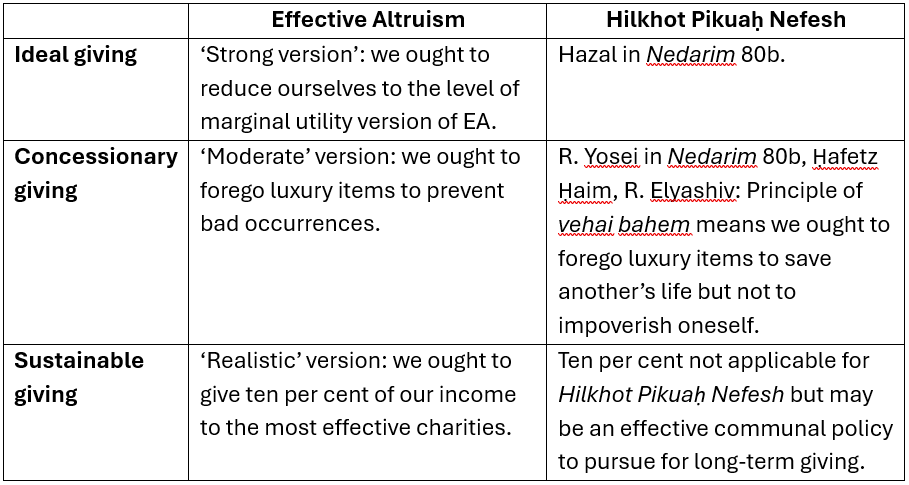
a. EA’s idealistic ‘strong’ version: we ought to reduce ourselves to the level of marginal utility, i.e. give away our wealth until we are nearly as poor as the people we are helping
b. EA’s concessionary ‘moderate’ version: we ought to forego luxury items to prevent bad occurrences
c. EA’s sustainable ‘realistic’ version: we ought to give ten per cent of our income to the most effective charities.[7]
2. ‘Effective’ altruism means working out what is the most good each of us can do. This requires evidencing which charities are most effective in terms of reducing human suffering, e.g. why donate $40,000 to supply one person in the United States with a guide dog, when the cost of preventing someone from going blind because of trachoma costs $20-$100? The same amount of money to help one person with a guide dog could have been used to prevent between four hundred and two thousand cases of blindness in developing countries (Singer 2015: 110-111). However, to be truly effective means thinking hard more broadly about our lifestyle choices. Beyond considering the opportunity cost of how we spend our money, there are sometimes counter-intuitive claims on how we live our lives. Thus, the EA concept of ‘earning to give’ suggests that rather an EA enthusiast go to work for a top investment bank and donate a significant proportion of their very high earnings to an effective cause than go to work for a charity organisation where their marginal output would be minimal in comparison to another humanitarian worker in the same job (MacAskill 2022b). At the same time, ‘effectiveness’ often means what can be sustained in the long-term: Singer accepts that very few of us are moral saints – especially over a long period – hence the ten per cent figure offered above. And so it is crucial to keep the (albeit demanding) balance to ensure sustainable giving over a lifetime in a realistic way that is appealing to as many of us as possible.[8]
3. ‘Effective altruism’ means that the “traditional distinction between duty and charity cannot be drawn, or at least, not in the place we normally draw it” (Singer 2016: 14). As Singer (ibid.) himself posits, the upshot of his argument “is that our traditional moral categories are upset.” In alignment with Jewish thought, Singer challenges the sharp distinction in Western society between charity and obligation that pervades our wider culture. The former is seen as voluntary and therefore giving charity is an act of “generosity”: although we praise the charitable person, those who don’t give are not condemned. As Singer writes:
People do not feel in any way ashamed or guilty about spending money on new clothes or a new car instead of giving it to famine relief. (Indeed, the alternative does not occur to them.) This way of looking at the matter cannot be justified. When we buy new clothes not to keep ourselves warm but to look "well-dressed" we are not providing for any important need. We would not be sacrificing anything significant if we were to continue to wear our old clothes and give the money to famine relief. By doing so, we would be preventing another person from starving. It follows from what I have said earlier that we ought to give money away, rather than spend it on clothes which we do not need to keep us warm. To do so is not charitable, or generous. Nor is it the kind of act which philosophers and theologians have called ‘supererogatory’—an act which it would be good to do, but not wrong not to do. On the contrary, we ought to give the money away, and it is wrong not to do so.
(Ibid.: 14-15)
Whilst this may be a revolutionary challenge for Western thinking, EA’s reframing of charity as a moral duty coheres with tzedaka as Halakha, not simply ‘good mussar’, i.e. a good thing to do. As R. Jonathan Sacks (2003) has noted, tzedaka is the “the untranslatable virtue” as it brings together two seemingly contradictory concepts: charity and justice. If I give someone money they are entitled to, then that is justice; but if they are not entitled, then that is an act of charity. For Sacks, the harmony of tzedaka as justice and charity together arises because of the Jewish theological distinction between possession and ownership: “What we possess,” Sacks writes, “we do not own – we merely hold it in trust for God.” As Tur (Yoreh De’ah 248) writes in his introduction to Hilkhot Tzedaka: “For one must understand that his money is merely a trust to be utilised to fulfil the wishes of the Grantor.”
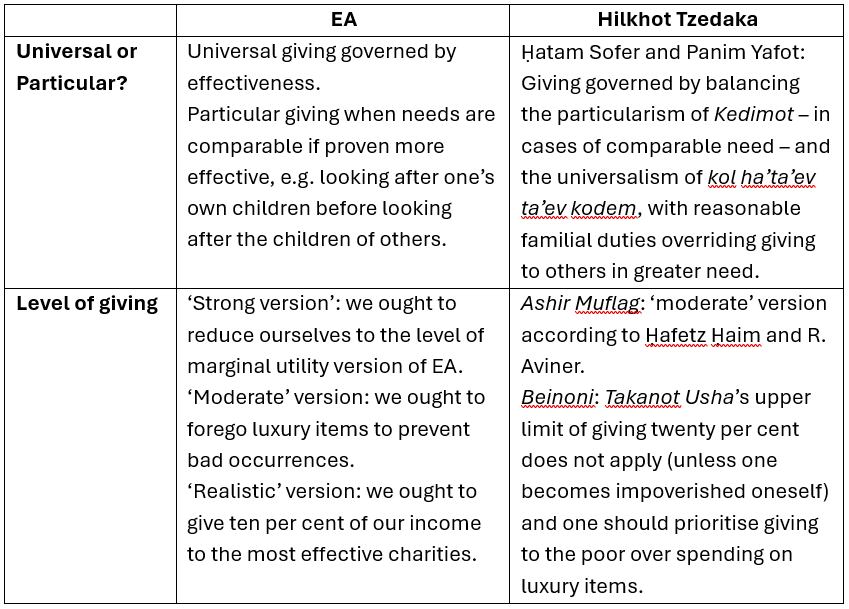
For many (e.g. Bregman 2025: 152) in secular Western culture, this is the major criticism of Singer’s argument: it requires too much of us. Taken to its strongest logical conclusion, Singer (2016: 28) writes that “we ought to give until we reach the level of marginal utility – that is, the level at which, by giving more, I would cause as much suffering to myself or my dependents as I would relieve by my gift.” Even Singer’s ‘moderate’ form of obligation – that we should prevent bad occurrences unless, to do so, we had to sacrifice something morally significant – would still require “a great change in our way of life is required,” which Singer accepts may still be too demanding for most to uphold. In recent years, he has since recommended a third ‘realistic’ tier of giving for the beinoni, i.e. the middle-class person, to give ten per cent of their earnings. “I think it’s an amount that most middle-class people can comfortably afford,” he says. “It depends on how much people are earning and how happy they are to live modestly.” For Singer this may well be the most “effective” option for most people as this is a lifestyle they can sustain in the long-term (cited in Bearne 2017).
Pikuaḥ Nefesh and Effective Altruism: Alignment or Divergence?
Let’s now return to Singer’s original thought experiment about the child drowning in a shadow pond, which is a crucial starting point to help us frame EA within the correct halakhic context.[9] In doing so, we can immediately recognise that the locus classicus for pikuaḥ nefesh is tantalisingly similar to Singer’s case. Sanhedrin 73a asks: “From where is it derived that one who sees another drowning in a river, or being dragged away by a wild animal, or being attacked by bandits, is obligated to save him?”
Just as Singer moves us from the supererogatory to the morally obligatory so too does the Gemara make it clear that we are obligated to save the person from a life-threatening situation, such as drowning, but on two separate grounds. First, in terms of the aseh, i.e. positive mitzvah, just as we are obligated to return a lost item to its owner (Deuteronomy 22:2), so too, must we ‘return’ a person’s body and restore their life. Second, we explicitly move into the category of pikuaḥ nefesh through the lo ta’aseh, i.e. prohibition of “lo ta’amod al dam re’eikha – not standing idly by the blood of your neighbour” (Leviticus 19:17). This aspect comes to teach us that a person is obligated to the extent of “even hiring workers, [i.e. experts who can save the person’s life, rather than endangering one’s own life] transgressing the prohibition if he does not do so.” Rashi (s.v. ka mashma lan) spells out that upon seeing another in life-threatening danger one is obligated to consider all means to save them so as not to transgress this prohibition.
Rosh, Sanhedrin 88:2, rules that the person saved must reimburse his rescuer – if he can afford it. Meiri (s.v. mi), based on Rosh, adds that even if the rescued party doesn’t have the means to pay back one is still obligated to spend the necessary funds to save his fellow’s life, “and whoever doesn’t do so, transgresses ‘not standing idly by the blood of your neighbour.’” [10] R. Asher Weiss takes up this analysis and at first glance his approach is in accordance with Singer’s ‘strong’ version:
Rather, the truth of the matter is that one needs to spend all his money in order to save even one life from Israel and to establish a whole world. And were it not for the specific principle of chayekha kodmin, i.e. that your life takes priority, one would have also been obligated to endanger one’s own life. And even halakhically it is the view of some authorities that one should enter into a safek sakanah, i.e. risk to one’s own safety, in order to save one’s fellow, and even losing a limb in order to save another’s life was weighed up by Radbaz III:623, and the main reason for ruling against this was because losing a limb itself could endanger one’s own life. However, with regards to money, then of course one must spend as much as is needed [to save a life], as some of the acharonim, i.e. later authorities, have ruled.
(2014a: 257)
In contrast, R. Yitzchak Zilberstein (cited in Ishun 1995: 315) cites R. Yosef Shalom Elyashiv, his father-in-law, who invokes the principle of “veḥai bahem,” i.e. live by the mitzvot (Bava Metzia 62a), and not impoverish oneself to a state of abject penury which is considered “ke’ein mavet – like death itself,” for one’s own life must take precedence. The debate here thus echoes Singer’s own ‘strong’ vs ‘moderate’ stances on saving lives as discussed above: whilst R. Weiss opts for the ‘strong’ version of EA, R. Elyashiv rules for the ‘moderate’ version. Either way, EA’s primary concern for the life you can save seems very much in line with Hilkhot Pikuaḥ Nefesh.
At the same time, we must explore three serious halakhic challenges to the principles of EA. First, what is one’s obligation if others can step in and share the burden, i.e. “efshar la’asotah al-yedei aḥerim”? Second, does Torah accept Singer’s view that it is irrelevant where the dying child is or is the obligation limited to when the potential victim is “lefanav,” i.e. in one’s proximity? Third, does Halakha recognise EA’s unapologetic universalism when it comes to saving lives?
i. Efshar la’asota within Pikuaḥ Nefesh
Despite R. Weiss’s strong stance on pikuaḥ nefesh, he goes on to conclude with a consideration of one’s duty when others are able to contribute to the cause:
In conclusion, it seems that it is clear in my humble opinion that a person is obligated to spend all his money to save one Jewish life. However, this is only in an extreme case where he alone can help for it is clear and simple that a person is not obligated to sell his own home and all he has in order to save an unwell person and a similar case [of someone in a life threatening situation] if others are present, for the mitzvot of the Torah are also incumbent upon them, and on this matter they said in Nedarim 65b: “All who become poor do not fall upon me. What is placed upon me to provide for him together with everyone else, I will provide to him.” See there. And this is simple.
(2014a: 257)
Yet it doesn’t seem so “simple” to this author. R. Weiss moves deftly from the category of pikuaḥ nefesh to that of tzedaka, citing Nedarim 65b which relates to a poor person in the context of communal charitable funds.[11] Although the principle of efshar la’asota unquestionably applies in the latter case of relieving poverty, this is difficult to square in matters of pikuaḥ nefesh. Rather, the multi-faceted principle of efshar la’asotah itself elegantly interacts wholly differently with regard to pikuaḥ nefesh – where it cannot excuse one’s inaction, precisely in contrast with issurim, i.e. prohibitions, where it limits one’s liability.[12] For the former, Yoma 84b relates this authoritative case:
One heats water for an ill person on Shabbat, whether to give him to drink or to wash him, since it might help him recover… And these acts should not be performed by gentiles or Samaritans but should be done by the leaders of the Jewish people, i.e., their scholars, who know how to act properly.
Thus, in this case, despite the fact that one can call on “gentiles or Samaritans” to help the ill person recover, and so limit one’s liability on Shabbat, the Gemara rules that such a consideration cannot operate as a constraint in the face of saving a life. Whoever can act, must act immediately. As Tosafot (s.v. ela b’gdolei Yisrael) put it: “And even where one may [carry out the act] through a gentile, it is a mitzvah for a Jew [to act directly] in case the gentile is tardy and won’t carry it out, causing danger [for the patient].” To be sure, Rema (Shulḥan Arukh, Oraḥ Ḥaim 328:12) cites Ra’avan that one may rely on a gentile when there is no delay. Nevertheless, where relying on others will cause a delay in action, all authorities agree that one’s responsibility is to act immediately. We simply cannot rely on others who may well delay or not live up to expectation, thus putting another’s life at risk. As R. Tatz (2025) puts it, “where others do not step up, there are no real ‘others’ and so of course one is obliged to help”. One would only be exempt when others are indeed fulfilling their obligations, which is sadly still not the case in terms of global need as millions of people continue to die each year from poverty-related diseases.
The Gemara continues:
One engages in saving a life on Shabbat, and one who is vigilant to do so is praiseworthy. And one need not take permission from a court but hurries to act on his own. How so? If one sees a child who fell into the sea, he spreads a fisherman’s net and raises him from the water. And one who is vigilant and acts quickly is praiseworthy, and one need not seek permission from a court, although in doing so he catches fish in the net as well. Similarly, if one sees a child fall into a pit and the child cannot get out, he digs part of the ground out around the edge of the pit to create a makeshift step and raises him out. And one who is vigilant and acts quickly is praiseworthy, and one need not seek permission from a court, although in doing so he fashions a step. Similarly, if one sees that a door is locked before a child and the child is scared and crying, he breaks the door and takes the child out. And one who is vigilant and acts quickly is praiseworthy, and one need not seek permission from a court, although he intends to break it into boards to be used later. Similarly, one may extinguish a fire by placing a barrier of metal or clay vessels filled with water in front of it on Shabbat when life is endangered. And one who is vigilant and acts quickly is praiseworthy, and one need not seek permission from a court, although he leaves the coals, which can be used for cooking after Shabbat.
(Yoma 84b)
Note that while each succeeding case moves further away from a direct threat to life, the ruling remains the same: one acts quickly and without seeking permission.[13]Shulḥan Arukh, Oraḥ Ḥaim 328:2, rules accordingly, pulling no punches: “For someone who has a dangerous illness, it is a commandment to break Shabbat for him. One who hurries to do this is praised. One who asks about this is a murderer.” It is thus clear that for issues of pikuaḥ nefesh, the concept of efshar la’asotah is irrelevant: there can be no reason to hesitate or delegate.
ii. Lefanav: Presence or Knowledge?
Nevertheless, in the cases cited above in Yoma 84b, there is a common thread that the obligation to act falls upon the person that “sees” the child in danger, i.e. that the person in need is lefanav – before him. Meanwhile, in justifying the universal obligatory nature of EA, Singer is unapologetic about lefanav not being a relevant factor:
19,000 children [die] every day. Does it really matter that we're not walking past them in the street? Does it really matter that they're far away? I don't think it does make a morally relevant difference. The fact that they're not right in front of us, the fact, of course, that they're of a different nationality or race, none of that seems morally relevant to me. What is really important is, can we reduce that death toll? Can we save some of those 19,000 children dying every day?
(2013)
Decisively, within the realm of pikuaḥ nefesh, the principle of lefanav is again irrelevant: both in terms of logic as well as our halakhic sources. Simply put, a major source for this halakhic category is the sadly still live issue of pidyon shvuyim – redeeming captives. As Rambam rules:
The redemption of captives receives priority over sustaining the poor and providing them with clothing. [Indeed,] there is no greater mitzvah than the redemption of captives. For a captive is among those who are hungry, thirsty, and unclothed and he is in mortal peril. If someone pays no attention to his redemption, he violates the negative commandments: “Do not harden your heart or close your hand” (Deuteronomy 15:7), “Do not stand by when the blood of your neighbour is in danger” (Leviticus 19:16), and “He shall not oppress him with exhausting work in your presence” (ibid. 25:53). And he has negated the observance of the positive commandments: “You shall certainly open up your hand to him” (Deuteronomy 15:8 , “And your brother shall live with you” (ibid. 19:18), “Love your neighbour as yourself” (Leviticus 19:18), “Save those who are taken for death” (Proverbs 24:11), and many other decrees of this nature. There is no mitzvah as great as the redemption of captives.
(Hilkhot Matnot Aniyim 8:10)
By definition, captives are not lefanav. For Rambam, it is the mere awareness combined with the capacity to help that enforces the obligation of to “not stand by when the blood of your neighbour is in danger.” More broadly, Rambam provides no limitation of physical proximity for the general principle of saving another’s life in Hilkhot Rotzeaḥu’Shmirat Nefesh 1:14: “Whenever a person can save another person's life, but he fails to do so, he transgresses a negative commandment, as Leviticus 19:16 states: ‘Do not stand idly by while your brother's blood is at stake.’”[14] This is echoed by Minḥat Ḥinukh 237 who rules that where one has the ability to save another but refrains from doing so transgresses “lo ta’amod al dam re’eikha.” Again, no mention is made of proximity.[15]
Similarly, we can see that lefanav had no bearing in the following historic case study. In 1932, R. Yisrael Meir Kagan (better known as Ḥafetz Ḥaim) and R. Ḥaim Ozer Grodzinski were moved to make the following appeal to British Jewry to save Jewish lives in Soviet Russia, describing them as “actually starving.” Just as they note that “the economic position of the whole world is a difficult one, this does not release us from our duty to be a brother to the afflicted in time of distress,” so too do they rule that it is “the bounden duty of every Jewish congregation in Britain to contribute all that they can” for this cause of pikuaḥ nefesh. Just as British Jewry is now bound by being made aware of the tragic circumstances of Russian Jewry, so too the community cannot relieve itself of their obligation based on efshar la’asota. Certainly, one potentially extenuating circumstance, all else being equal, would have been a conflicting demand on saving “actually starving” Jews in the UK due to the principle of “ein ma’avirin al hamitzvot,” i.e. that one may not bypass a mitzvah (Yoma 33a, Pesachim 64b), and so where there is comparable pikuaḥ nefesh need one may not ignore one’s obligations closer to home (Tatz 2023). However, that was not the case then and certainly not the case now in any Western Jewish communities. Rather, the language of the notice in the name of the two halakhic authorities arguably mirrors Singer’s ‘moderate’ version of EA, saying that despite the economic woes of Jews in Britain – at a time of global financial crisis – they were still obligated to save the lives of their brethren due to the obligation of pikuaḥ nefesh, with an implicit expectation to forego luxury items as “[e]veryone who has the slightest opportunity of participating in this great work of mercy must on no account refrain.”

Figure 1: Appeal to British Jewry to save “actually starving” Russian Jews in 1932.
This approach is supported in Ḥafetz Ḥaim’s own Ahavat Ḥessed 20:2 where in his analysis on the rabbinic decree in 140s CE limiting charitable giving to twenty per cent of one’s wealth (known as Takanot Usha) within the context of pikuaḥ nefesh, he states:
Where one wishes to give more than a fifth [for charitable causes] then one may do so, and this is considered a pious attribute. Yet it seems to me that this is for a charitable cause that doesn’t relate to actual pikuaḥ nefesh. But where the cause actually saves lives, e.g. where the captive is about to die or where his hunger is life-threatening, then the one-fifth limitation doesn’t apply. For they (Bava Metzia 60b) only said ‘your life takes precedence over your friend’s life’ but we don’t find anywhere the claim that your wealth should take precedence over your friend’s life.
Ḥafetz Ḥaim’s ruling that a person’s wealth cannot take precedence over another’s life is akin to Singer’s ‘moderate’ version of giving: we ought to forego luxury items for pikuaḥ nefesh. To be sure, R. Yishmael HaCohen specified in Zera-Emet 2:51 that even though one would need to give up the valuables in one’s home to save a life, one wouldn’t be required to actually sell one’s home to avoid transgressing “lo ta’amod al dam re’eikha.” As R. Shomo Ishun (1995: 317) concludes: “it would seem that one’s minimal needs do take priority over the life of another.”
We can go further. In the talmudic case of “ma’ayan shel bnei ha’ir,” a spring that originates in one town and flows through another, Nedarim 80b rules as follow:
In the case of a spring belonging to the residents of a city, if the water was needed for their own lives, i.e., the city’s residents required the spring for drinking water, and it was also needed for the lives of others, their own lives take precedence over the lives of others. Likewise, if the water was needed for their own animals and also for the animals of others, their own animals take precedence over the animals of others. And if the water was needed for their own laundry and also for the laundry of others, their own laundry takes precedence over the laundry of others. However, if the spring water was needed for the lives of others and their own laundry, the lives of others take precedence over their own laundry. R. Yosei disagrees and says: Even their own laundry takes precedence over the lives of others.
Again, the narrow debate between Ḥazal and R. Yosei are framed within Singer’s ‘strong’ vs ‘moderate’ versions of EA. Ḥazal prioritise the lives of others even over essential necessities of laundering clothing (which has its own health implications) and so lean towards the view that we ought to reduce ourselves to the level of marginal utility in order to save the lives of others. In contrast, R. Yosei felt that the dangerous consequences of foregoing the essential water to save others would put the town itself in danger.[16] Thus, for R. Yosei, luxuries should be given up to prevent the deaths of others, but necessities such as water for laundry can be legitimately claimed. Either way, and as Ḥafetz Ḥaim ruled, there is simply no view that accepts prioritising luxury items over saving the lives of others.
iii. Pikuaḥ Nefesh: Particular or Universal?
Thankfully, in just under 100 years, such notices about our Jewish brethren “actually starving” is a world away. In more universal terms though, despite the unparalleled economic growth of the last seventy-five years or so, millions of people remain in abject poverty in many parts of the world. To be clear, in the 40 minutes or so that it takes you to read this article, some 450 children will have died from poverty-related disease.[17] Quite simply, therefore, the question before us is: what are our obligations towards these non-Jewish children at a time when no member of Am Yisrael is suffering in a comparable manner?
It must be noted that for many, there are historical and hashkafic barriers that intuitively prevent our move from the particular towards the universal. As R. Aharon Lichtenstein observed, the considerations in this article are necessarily new in our globalised age:
The live option herein presented [with regard to an outward-looking focus in charitable giving] would probably not even have occurred to insular Jewish communities in Poland or Morocco. On the one hand, they lacked the means to expand their philanthropic activity significantly, and, given their relatively limited interaction with the broader world, were also generally bereft of the impulse to do so. On the other hand, inasmuch as the general welfare state within which post-Emancipation Jewry could find its niche had yet to assume part of the burden of supporting Jewish individuals and institutions, the obligation of family and indigenous kehillah to minister to our own was more keenly felt.
(2010: 213)
Nevertheless, a post-Holocaust world of relative affluence and civil liberties for global Jewry must stand against generations of communal poverty combined with pervading antisemitism. That long-standing reality of anti-Jewish hatred unquestionably casts a long shadow over the Jewish sense of universal responsibility. On the one hand, the inward-looking focus binds us a people and creates unrivalled networks of support that are truly inspiring. On the other hand, R. Lichtenstein (1999: 59) himself bemoaned how a lack of outward-looking focus sadly blinds us from the suffering of the other: “the tendency, prevalent in much of the contemporary Torah world in Israel as well as in the Diaspora, of almost total obliviousness to non-Jewish suffering is shamefully deplorable.”
Deplorable perhaps, but not surprising. Overwhelmingly, the sense of Jewish separateness, as an Am levadad yishkon (Numbers 23:9), very much frames much of our socio-historic reality. Due to wide-spread antisemitism still apparent in the diaspora, let alone in the new guise of anti-Zionism, the resultant insular psyche in the Orthodox world is hard to shake off. At a time when Israel and global Jewry are still reeling from the October 7 terror atrocities and attendant rise in attacks on Jews across the world, the move to particularism is felt even stronger and for understandable reason.
Still, at a time of incomparably greater antisemitism, when world Jewry was left at the mercy of their non-Jewish hosts, we can be inspired by Gittin 61a, as codified by Rambam, Hilkhot Matnot Aniyim 7:7, which ruled: “One sustains poor gentiles along with poor Jews, and one visits sick gentiles along with sick Jews, and one buries dead gentiles along with dead Jews. All this is done on account of the ways of peace.” Beyond the pragmatic consideration for “the ways of peace,” which in itself is far-reaching, R. Lichtenstein (cited in Ziring 2024) argued that the saving of a gentile’s life is mandatory (even in a case of violating Shabbat) based on principle, and so would apply even where “there would be no problem of negative results.” Whether on grounds of principle or pragmatism, it is clear, as R. Joseph Soloveitchik (cited in Shrage 2010: 131) wrote, that “insularity cannot be vindicated as authentic Judaism even if it can be understood and justified in particular historical periods and situations.” With millions of children continuing to die from poverty-related diseases, it cannot be that we who are called upon to imitate God’s ways should not feel a sense of universal responsibility and demonstrate “compassion over all He has made” (Psalm 145:9). At the level of pikuaḥ nefesh, therefore, we have seen a clear alignment between Halakha and EA with regard to our universal obligations, especially where there is no comparable concern for Jewish life. In a world where we know that millions of people are dying of poverty-related diseases each year, and we have the means to direct our funds into making a real difference in today’s age of technology and globalisation – unlike our ancestors in the past – the demands on Orthodox Jewry are real even if not keenly felt for a variety of hashkafic and historical reasons.[18]
Table 1: Summary for Hilkhot Pikuaḥ Nefesh and Effective Altruism
Tzedakah and Effective Altruism: Alignment or Divergence?
This article has argued that the unconscionable global reality of millions of people dying of poverty-related diseases each year means that the Halakha primarily frames the demands of EA within Hilkhot Pikuaḥ Nefesh. Within that narrow but decisive framework we have seen a welcome opportunity that EA affords the Orthodox Jewish community in terms of our universal obligations. Nevertheless, at a secondary level, it is still important to consider the philosophy of EA in terms of tzedaka and our charitable obligations to the other. Namely, how do the principles of EA square with Hilkhot Tzedaka with regard to non-life saving charity donations?
Singer’s EA challenge in terms of tzedaka elicits contradictory feelings for the halakhically observant. On the one hand, we are heartened by EA elevating charity from the supererogatory to the morally obligatory. As the data shows (see, for example, Putnam and Campbell 2010), for the vast majority of people, charitable giving as a way of life is simply not part of the secular mindset in the Western world. Religious people give more and volunteer more. Interestingly, as Campbell (2010) points out, this is not because of belief but rather because of congregational influences: the greater one’s religious praxis, the more likely one is to give to charity. Thus, EA’s demand for morally obligatory giving is one that halakhically observant Jews should hardly find daunting.
On the other hand, there are three assumptions of EA that must be explored within the halakhic principles underpinning tzedaka. First, we will need to examine how EA’s principle of universalism squares up against the halakhic guide of precedence known as Kedimot, i.e. ordo caritatis. Second, we will weigh up EA’s overriding goal of effectiveness against the balancing act of Kedimot with “kol ha-ta’ev, ta’ev kodem,” i.e. those most in need come first. Third, we will analyse EA’s ‘strong’ and even ‘moderate’ versions of giving in light of the well-known Takanot Usha which placed an upper limit on giving, i.e. one-fifth of one’s wealth.
i. Kedimot: Particularism vs Universalism
In contrast to Singer’s universalist assumption, Kedimot suggests that it absolutely does matter who the recipient is and where they live. To draw out the difference between these two positions let’s examine the character of Mrs Jellyby in Charles Dickens’ great novel, Bleak House. Satirising the Victorian middle-class obsession with social causes abroad, Dickens’ character, Mrs Jellyby, infamously neglects her husband and children as she can “see nothing nearer than Africa!” Dickens calls this phenomenon ‘telescopic philanthropy’ as Mrs Jellyby’s eyes are closed off to the squalour around her as she puts all her efforts into supporting the far-off natives of ‘Borrioboola-Gha’ in Africa (see John Tenniel’s classic cartoon below). Whilst a follower of EA may applaud the principle underlying Mrs Jellyby’s philanthropy – assuming the poor Africans objectively need more help than her husband and children – it is clear that Ḥazal would not have been impressed with Mrs Jellyby’s misplaced focus.
Figure 2: Mrs Jellyby’s ‘telescopic philanthropy’ in Charles Dickens’ Bleak House.
As Deuteronomy 15:7-8, the locus classicus for tzedaka, reads:
If, however, there is a needy person among you, one of your kin in any of your settlements in the land that your God is giving you, do not harden your heart and shut your hand against your needy kin. Rather, you must open your hand and lend whatever is sufficient to meet the need.
Bava Metzia 31b itself, initially assuming an obligation only to “aniyei irekha,” i.e. the poor of one’s own locale, shows how this passage teaches us otherwise:
“For the poor shall never cease out of the land; therefore I command you, saying: You shall open [Patoaḥ tiftaḥ] your hand to your poor and needy brother in your land” (Deuteronomy 15:11). I have derived only the obligation to give charity to the poor residents of your city. From where is the obligation to give charity to the poor residents of another city derived? The verse states: “Patoaḥ tiftaḥ,” to teach that you must give charity to the poor in any case.
Such an expanding circle of responsibility, from the particular to the universal—but prioritising the former—is spelled out most famously in the Sifri, Devarim 116:
“If, however, there is a needy person among you”: and not others, i.e. gentiles.
“evyon, i.e. needy person”: the neediest takes precedence.
“of one of your brothers”: this is your brother from your father;
“one of your brothers”: your brother from your father takes precedence to your brothers from your mother.
“in one of your gates”: the inhabitants of your city take precedence to those of another.
“in one of your gates”: If he sits in one place you are obliged to help him; if he goes begging from door to door you are not obliged to do so.
“in your land”: The inhabitants of Eretz Yisrael take precedence to those who live outside the land.
“that the Lord your God gives to you": (This extends the obligation) to all places.
Kedimot is codified by Rambam, Hilkhot Matnot Aniyim 7:13, as well as Tur and Shulḥan Arukh, Yoreh De’ah 251. To be sure, as R. Yehudah Zoldan (2015: 38) notes, it is unclear whether Kedimot is merely good guidance, a rabbinic obligation, or even a Torah obligation. R. Weiss (2014b: 151) opines that it is good guidance and a pious attribute. Nevertheless, Rambam’s defence of preferential love is no concession to human nature or social reality but “an excellent moral quality,” which the Halakha “safeguards and fortifies”:
The Torah has taught us that one must go exceedingly far indeed in the exercise of this moral quality. Namely, man ought to take care of his relative and grant very strong preference to the bond of the womb.
(Guide for the Perplexed III: 42)
Quite simply, Mrs Jellyby is a problematic if absurd character within the ethic of Hilkhot Tzedaka which emphasises that the starting point of one’s circle of responsibility is oneself and one’s home. As Dickens (1991: 37) describes his EA heroine: “Mrs Jellyby had very good hair but was too much occupied with her African duties to brush it.” In contrast, Rema, Yoreh De’ah 251:3, rules on Kedimot: “Sustaining oneself takes precedence over sustaining anyone else and one needn’t give tzedaka until he is secure in his own standard of living.”
Such particularism in Hilkhot Tzedaka stands in stark contrast with Singer’s famous justification of universal and equal care for the other, including animals:
The circle of altruism has broadened from the family and tribe to the nation and race, and we are beginning to recognise that our obligations extend to all human beings. The process should not stop there. In my earlier book, Animal Liberation, I showed that it is as arbitrary to restrict the principle of equal consideration of interests to our own species as it would be to restrict it to our own race. The only justifiable stopping place for the expansion of altruism is the point at which all whose welfare can be affected by our actions are included within the circle of altruism. This means that all beings with the capacity to feel pleasure or pain should be included...
(1981: 120)
Singer elevates reason over love and empathy as the credible form of motivation for altruism. Citing Henry Sidgwick, the great 19th century utilitarian philosopher, Singer invokes universalism through the maxim of benevolence by recognising our responsibility from “the point of view of the Universe,” i.e. impartially, as Mrs Jellyby sees it:
Each one is morally bound to regard the good of any other individual as much as his own, except in so far as he judges it to be less, when impartially viewed, or less certainly knowable or attainable by him.
(2015: 81-82)
Within the narrow confines of Hilkhot Tzedaka, EA’s universalist nature is thus left wanting. R. Ozer Glickman (2010: 286) noted sharply that: “Many Jews may be surprised to discover that they may not be fulfilling the mitzva of tzedaka even if they write regular checks to nonprofit institutions. Tzedaka is the extension of support to a poor Jew.” With a concession only for supporting Torah institutions, we can see that the philosophically particularist underpinnings of Hilkhot Tzedaka are wholly different from the universalist and impartial EA worldview. As R. Glickman concludes:
The base case for tzedaka is the support of the local poor.
This is the force of the Sifri… The drasha [i.e. homily] envisions charitable responsibilities in widening social and geographic circles while respecting the local nature of the primary obligation through the notion of precedence. Tzedaka is essentially a relationship between two human beings, one needy and the other able to provide.
(Ibid.)
ii. Kol ha-ta’ev, ta’ev kodem: Proximity vs Urgency
So much for universalism. Yet we certainly need not give up on the importance of ‘effectiveness’ within Hilkhot Tzedaka. The principle remains but we shall see a more complex balancing act for halakhic giving than EA’s elegant calculus of working out “the most good you can do.”
Whilst Kedimot is the most well-known prioritisation principle, and so provides an expanding circle of responsibility, from the particular to the universal, it is not the only one. Thus, R. Moshe Sofer, Teshuvot Ḥatam Sofer, Yoreh De’ah 231 ruled that the priority of proximity only applies in cases of comparable need. His basis is the principle of kol ha-ta’ev, ta’ev kodem, which is gleaned from the word “evyon – the needy person” coming first in the Sifri’s list of priorities spelled out above. R. Pinchas HaLevi Horowitz rules similarly in his Panim Yafot on Deuteronomy 15:7.
Even so, R. Daniel Z. Feldman (2021) notes that for both authorities, familial duties still come first. For the Panim Yafot, “[w]hen family is concerned, their needs come first, even if others outside the familial group are more urgently lacking.” Meanwhile, for Ḥatam Sofer, even “he dispensed with this standard [of prioritising the neediest] when the recipient was the donor’s father” due to special obligations a child has towards their parent. Unlike Mrs Jellyby, whose only concern is for kol ha-ta’ev, ta’ev kodem, the halakhic donor must balance this with his or her familial duties. David Edmonds (2025: 144) provides a helpful critique of Mrs Jellyby’s approach, even if she had proven to be an effective altruist: “Special obligations to our children are morally foundational, of an entirely different order from our obligations to needy strangers. They’re not based on any calculus of utilitarian efficiency.” So too, Hilkhot Tzedaka, as exemplified by Kedimot, are not merely about outcome but also about the donor and their relationship with the recipient. As Rambam (Hilkhot Matnot Aniyim 10:1) put it in a decidedly non-utilitarian manner: “We are obligated to be careful with regard to the mitzvah of charity to a greater extent than all other positive commandments, because charity is an identifying mark for a righteous person.”
Thus, a careful balance is recommended, with Ḥatam Sofer (ad. loc.) ruling that one’s priorities in giving should be proportionate. Simply put, it would be difficult to justify buying the latest electronic gadget for my child over my giving to local families in need of food for sustenance. Other authorities have advised diversifying one’s giving, based on Eruvin 63a and codified in Shulḥan Arukh, Yoreh De’ah 257:9: “One should not centre all his charities in one poor man.” Kerslowe (ad. loc.), for example, cites R. Hershel Schachter recommending an 80-20 split in favour of local charities vs more global causes. Meanwhile, R. Weiss (2014b: 151) recommends giving “some to Talmud Torah, some to the poor, as well as to similar charities for good causes.”
iii. Takanat Usha and its exceptions
Takanot Usha were a series of rabbinic decrees passed in the Galilean city of Usha that provided the values for communal life in the wake of the Bar Kochba revolt in 135CE and subsequent Hadrianic persecutions. This historical context is important for understanding the rabbinic concern for impoverished Jewish communities in Eretz Yisrael and how they could be sustained. In such a terrible economic and social climate, children were being neglected, with central communal funds being relied upon to care for their welfare. In turn, Ketubot 49b tells us: “In Usha Ḥazal instituted that a man should sustain his sons and daughters when they are minors.”
Complementing this rule, Ketubot 50a continues: “In Usha Ḥazal instituted that one who dispenses his money to charity should not dispense more than one-fifth.” Whether Ḥazal were concerned for the idealistic effective altruists of their day or ascetics eschewing material wealth for the spiritual life (as was growing popular among early Christians), the drive for self-help and economic realism is clear. To this end, Ketubot 50a goes on to tell the anecdote of R. Yeshavev who was prevented by his friend, R. Akiva, from giving more than 20 per cent of his property to charity “lest he render himself destitute and need the help of other people.”
Let’s consider the character of Elazar Ish Birta (or Birtuta) in more depth from Ta’anit 24a:
Whenever the charity collectors would see Elazar of the village of Birta, they would hide from him, as any money Elazar had with him he would give them, and they did not want to take all his property. One day, Elazar went to the market to purchase what he needed for his daughter’s dowry. The charity collectors saw him and hid from him. He went and ran after them, saying to them: I adjure you, tell me, in what mitzva are you engaged? They said to him: We are collecting money for the wedding of an orphan boy and an orphan girl. He said to them: I swear by the Temple service that they take precedence over my daughter. He took everything he had with him and gave it to them. He was left with one single dinar, with which he bought himself wheat, and he then ascended to his house and threw it into the granary. Elazar’s wife came and said to her daughter: What has your father brought? She said to her mother: Whatever he brought he threw into the granary. She went to open the door of the granary, and saw that the granary was full of wheat, so much so that it was coming out through the doorknob, and the door would not open due to the wheat. The granary had miraculously been completely filled. Elazar’s daughter went to the study hall and said to her father: Come and see what He Who loves you, the Almighty, has performed for you. He said to her: I swear by the Temple service, as far as you are concerned this wheat is consecrated property, and you have a share in it only as one of the poor Jews.[19]
Much like the hapless Mrs Jellyby, Elazar Ish Birta is certainly altruistic even if ineffective. Whereas the Almighty is described as “He Who loves you,” and so suggests Divine approval for his largesse, the story leaves us intuitively crying out for his long-suffering wife and daughter. The battle between a more universal love, known as agape within Christian thought, and Jewish concern for Kedimot is being played out in this Ish Birta family drama. And the Sages of Usha clearly ruled in favour of the familial obligation, known as storge, to prevent parents from negating their very natural duties towards their families in favour of more distant causes.
But it would be too simplistic to stop there. In his analysis of Takanot Usha in Ahavat Ḥessed 20:1, Ḥafetz Ḥaim expands the scope for EA within Hilkhot Tzedaka in two major ways. First, citing the Ḥokhmat Adam 144:10, he notes that because the enactment was instituted so that one doesn’t fall into penury oneself, the takanah does not apply to an “ashir muflag” i.e. a particularly wealthy individual who needn’t fear such an eventuality.[20] Moreover, we may extend this exemption to giving away one’s wealth (without any limitations) just before one dies, which Ḥafetz Ḥaim notes is what Mar Ukva did in Ketubot 67a. It is interesting to note that on similar grounds EA has been particularly popular with the wealthiest through the Giving Pledge, set up by Bill Gates, Melinda French Gates, and Warren Buffett, which was “launched in 2010 to unlock vast resources to address the world’s most urgent issues.” To this end, the Giving Pledge “is a promise by the world’s wealthiest philanthropists to give the majority of their wealth to charitable causes in their lifetime or wills.”[21]
Second, Ḥafetz Ḥaim (op. cit. 20:8) analyses the use of the word “mevazvez,” i.e. wasting or squandering one’s wealth. His focus duly turns to the ‘effective’ use of one’s wealth: “From the takanah enacted by Ḥazal, we can contemplate how important it is for a person to look after their money, and not to waste their wealth on inyanei hevel.” Whether we translate these items of vanity as luxury items or simply things we don’t need, Ḥafetz Ḥaim warns against the trap of “keeping up with the Joneses,” so prevalent in many of our middle-class communities. Whether it is spending relatively large amounts on clothes and the finest items, mansions, or luxuriating on excessive help, Ḥafetz Ḥaim warns that such waste will only lead one to ruin – both material and spiritual. Rather, he concludes: “Every discerning person should not waste his money on vanity and emptiness, but rather on necessary items and for tzedaka and ḥessed, and so they will benefit.”
This turn to the effective use of one’s resources also correlates with Singer’s appeal to the EA way of life being a meaningful one that brings huge benefits to the giver, surely in keeping with Torah values:
Being an effective altruist helps to overcome what I call the Sisyphus problem. …Sisyphus [is] condemned by the gods to push a huge boulder up to the top of the hill. Just as he gets there, the effort becomes too much, the boulder escapes, rolls all the way down the hill, he has to trudge back down to push it up again, and the same thing happens again and again for all eternity. Does that remind you of a consumer lifestyle, where you work hard to get money, you spend that money on consumer goods which you hope you'll enjoy using? But then the money's gone, you have to work hard to get more, spend more, and to maintain the same level of happiness, it's kind of a hedonic treadmill. You never get off, and you never really feel satisfied. Becoming an effective altruist gives you that meaning and fulfilment. It enables you to have a solid basis for self-esteem on which you can feel your life was really worth living.
(2013)
R. Shlomo Aviner goes even further, citing the following dictum from R. Avraham Yitzchak Ha-Kohen Kook (Orach-Mishpat, Orach Chayim 128:54): “One should be particularly careful about tzedaka, and one must know that what pertains to the life of a poor person takes priority over all luxuries in one’s own life, according to our Holy Torah.”
With the limitation of one-fifth not applying to the wealthy, R. Aviner takes up EA’s ‘moderate’ approach for anyone living beyond the beinoni, i.e. average middle-class income. As he writes:
And we may deduce that the reason for the takanah is so that “one isn’t financially dependent on others.” Therefore, a wealthy person can give huge amounts until he reaches the level of a beinoni, for even a beinoni is not forbidden from giving up to a fifth, for they weren’t concerned that because of this a person would become dependent on others.
(2008: 54)
Citing Ḥafetz Ḥaim’s guidance on spending money on worthwhile causes over vanity and nonsense, R. Aviner argues that because wealth cannot be prioritised over the life of others, any expenditure on luxury items, i.e. those goods and services beyond the means of a beinoni, is unacceptable. For R. Aviner, living within “financial capacity” means being able to afford the essentials for living as a beinoni. In this vein, when Tur, Yoreh De’ah 251 and Rema, ibid.:3 write of a person’s livelihood taking priority, they are clearly speaking of necessities for living a dignified, beinoni life. R. Aviner concludes:
This is the principle: a wealthy person is obligated to give from his wealth to the poor, even if this means lowering his own wealth to that of a beinoni – average in society, in order to fulfil the needs of the poor, i.e. their essential needs for living. (ad. loc.)
Teshuvot Ḥatam Sofer, Yoreh De’ah 229 wrote in similar terms:
According to the Torah, as long as a person can sustain their day-to-day living, they are obligated to give the rest to the poor. It was only in Usha that they enacted that a person should not squander more than a fifth.
With the reason being that this could lead to donors becoming dependent on welfare themselves, it is clear that for many of us in our modern, middle-class environment, the one-fifth limitation of Takanat Usha no longer applies.
Thus, R. Aviner’s principle arguably accords with Singer’s ‘moderate’ version, i.e. that we ought to reduce ourselves to the level of a beinoni within the parameters of Hilkhot Tzedaka.[22] After one has sustained oneself and family in terms of the necessities of life, any excess should be reserved for those who need it more. Here he cites the Ba’al HaTanya, Iggeret-HaKodesh 16, for support, which is worth quoting in full:
As to the ruling of Ḥazal (Bava Metzia 62a) that “Your own life takes precedence,” this applies only in a case “when one has a pitcher of water in hand…,” that is, when it is equally essential that both drink in order to save their lives from thirst.
But if a pauper needs bread for the mouths of babes, and firewood and clothes against the cold, and the like, then all these take precedence over any fine apparel and family feasts, with meat and fish and all kinds of delicacies, for oneself and all of one’s household.
The rule that “your own life takes precedence” does not apply in such a case, because these are not really essential to life, as are [the needs] of the poor, in true equality, as is discussed in Nedarim 80b. Now, the above follows the exact requirements of the law.
In fact, however, even in a case where such reasoning does not so fully apply, it is not proper that any man insist on the letter of the law; rather, he should impose austerity on his own life and go far beyond the [demands of the] letter of the law.
Moreover, one should be concerned, for his own sake, with the teaching of Ḥazal, that—even in a situation where “that which is yours takes precedence over that which belongs to others”—he who is exacting in this matter, and does not go beyond the letter of the law, “will eventually be brought to this matter”: he himself will ultimately need charity, heaven forfend.
And after all, all of us need the mercies of heaven at all times, [which are elicited] only through an arousal from below, at all times and at every moment, by arousing our compassion for those who are in need of compassion.
But whoever hardens his heart and suppresses his compassion, for whatever reason, causes the same above—the suppression of [Divine compassion], heaven forfend.
Certainly, R. Aviner and Ḥafetz Ḥaim take issue with EA’s universalism. However, they are still bound by the principle of ‘effectiveness’ albeit in the frameworks of Kedimot and kol ha-ta’ev, ta’ev kodem. The marginal utility of providing for the poorest in society far surpasses the benefit of being “mevazvez” our wealth on “inyanei hevel” and so the ‘moderate’ version does seem in keeping with Hilkhot Tzedaka.
In a sharp critique of R. Aviner’s “provocative” ruling on tzedaka, R. Chaim Jachter (2011) posits that because the Torah itself (Exodus 30:15) “describes both wealthy and poor individuals in Am Yisrael,” this structural reality is part of the capitalist society that “the Torah essentially advocates… although with some limitations.” In turn, he rejects R. Aviner’s “vision of a financially egalitarian society.” However, R. Jachter makes a formal error in his analysis. As the Israeli philosopher Yeshayahu Leibowitz (1997) pointed out, there are fundamentally two kinds of halakhot: those that create relationships and those that regulate relationships already in existence. Private law that governs religious and interpersonal behaviour is of the first kind, and the social law is of the second. R. Sacks (2023: 151) explains: “The Torah did not create ideal social institutions de novo. Instead it took the forms already extant in society and proceeded to regulate them, slowly moving towards an ideal.” It is true that the Torah speaks of poor people, but it also speaks of slaves. Just as it would be absurd to imagine that the ideal Torah society includes slavery, so too would it be difficult to argue that it should include poverty.
In any case, proponents of EA, led by Singer himself, usually accept that the capitalist system remains the most robust way for generating wealth than any other (see, for example, Singer and Lewis 2010). Foregoing luxury items in favour of saving lives in no way hampers capitalism. Remember, Singer lauds entrepreneurs like Gates and Buffett as well as those in finance and commerce for using their wealth in effectively altruistic ways. It is precisely by using the capitalist system for charitable purposes that Singer thinks we can make the most impactful change. Where the idealistic ‘strong’ version proves too much – which Singer accepts it is for most – then EA concedes a ‘moderate’ version or even a more ‘realistic’ ten per cent, that prove more sustainable for the long term for most people.
Yet my own anecdotal experience tells me that the barriers may be even higher within the halakhic community. Minhag avoteinu beyadenu, i.e. long-standing practice, reigns supreme for many, and the mimetic tradition means that a re-evaluation of the sources in light of EA and the modern context will be an uphill struggle in two ways. First, although EA’s sustainable stance of ten per cent is feasible and very much the reality for many in the Torah world already, the move to the ‘moderate’, let alone the ‘strong’, version of EA, will be too much to bear. Second, local Jewish charities are overwhelmingly preferred to global, non-Jewish charities – especially in times of heightened antisemitism, which is all too sadly the reality, even today.
Table 2: Summary for Hilkhot Tzedaka and Effective Altruism
Conclusion
That this article has analysed EA through the prism of different categories of Halakha – namely Pikuaḥ Nefesh and Tzedaka – in itself speaks of the contrast in the underlying philosophies of EA and Halakha. The former ultimately stems from Jeremy Bentham’s principle of utility, i.e. the greatest happiness for the greatest number (see, for example, Sweet n.d.). Adherence to this single principle allows EA to be resolutely focused on how one can best maximise their giving to produce the most good for the most people. This logical universalism remains true at all levels of giving for EA.
In contrast, the latter is governed by a plurality of independent norms that aren’t deducible from any single principle (see, for example, Wurvurger 1994: 40). To be sure, in terms of Hilkhot Pikuaḥ Nefesh we saw an alignment with EA in terms of the universal obligation to save other lives. Nevertheless, we also a saw clear divergence within Hilkhot Tzedaka as we took up competing particularist halakhic principles – including Kedimot and “kol ha-ta’ev, ta’ev kodem” – which required a careful balance in terms of one’s obligations. Such a pluralist philosophy of Halakha was most famously championed by Saadia Gaon:
…I have seen people who think – and with them it is a firm conviction – that it is obligatory for human beings to order their entire existence upon the exploitation of one trait, lavishing their love on one thing above all others… Now I have investigated this view and I found it to be extremely erroneous for sundry reasons.
One of these it that if the [exclusive] love for one thing and its preference [above all others] had been the most salutary thing for man, the Creator would not have implanted in his character the love for these other things.
(1999: 188)
Just as the Halakha applauds universalism at the level of saving lives, so too does it champion particularism at the level of tzedaka. In sum, the Halakha rails against relying on one simple principle to frame all of our obligations to the other, however elegant it may seem. Rather, our complex world demands a plurality of values that need to be weighed carefully so that we fulfil our halakhic duties in the most optimal of ways.
Acknowledgements
Many thanks to Rabbi Dr Akiva Tatz, Ashley Hirst, and Dr Donald Franklin for kindly reading through earlier drafts and providing highly effective feedback. Their insightful comments have done much to improve the article for which I am very grateful. Of course, the conclusions I reach are my own.
Endnotes
[1] EA has blossomed as has the literature surrounding it. For an excellent overview, see David Edmonds (2025), Death in a Shallow Pond. From the effective altruists themselves see William MacAskill (2022a), What We Owe the Future, and Peter Singer (2015), The Most Good You Can Do.
[2] For better, see Peter Singer’s 2013 TedTalk, ‘The why and how of effective altruism’: https://www.ted.com/talks/peter_singer_the_why_and_how_of_effective_altruism. For worse, see The Economist (2013), ‘What Sam Bankman-Fried’s downfall means for effective altruism’: https://www.economist.com/briefing/2022/11/17/what-sam-bankman-frieds-downfall-means-for-effective-altruism.
[3] Benjamin Kerslowe (2023), ‘Effective Altruism and Tzedaka,’ provides a helpful introduction to the topic: https://www.yutorah.org/lectures/1067154/Effective-Altruism-and-Tzedakah. For a fuller discussion of tzedaka in modern life, see Yossi Prager (ed.), (2010), Toward a Renewed Ethic of Jewish Philanthropy; interestingly, the term, ‘Effective Altruism’, doesn’t appear in the volume.
[4] This article will not delve into apologetics or broader issues of Jewish influence that are no doubt important for Jewish communal leaders to consider. Equally, this is not the forum for discussing the wider socio-economic debates surrounding EA. For such a discussion, see Angus Deaton (2013), The Great Escape, Chapter 7. My thanks to the British philosopher David Edmonds for bringing Deaton’s critique of EA to my attention.
[5] According to the World Health Organisation, an estimated 5 million children under the age of 5 years died in 2020, mostly from preventable and treatable causes. Approximately half of those deaths, 2.4 million, occurred among newborns in the first 28 days of life. See: https://www.who.int/news-room/fact-sheets/detail/child-mortality-under-5-years. Despite these harrowing figures, these numbers are actually a lot better than when Singer wrote his essay in 1971.
[6] See https://www.givewell.org/charities/top-charities for the cost-effectiveness of the world’s top charities.
[7] Of course, Singer gets this figure from ma’aser, the tithe set aside in Jewish and Christian practice based on Genesis 14 and 28, in itself an effective and inclusive use of religious ethics.
[8] The tragic story of the American altruist George R. Price (1922-1975), a brilliant and eccentric scientist, is a helpful case to consider. Whilst altruistic, one may question his ‘effectiveness’. See, for example, James Schwartz (2000), ‘Death of an Altruist,’: https://bio.kuleuven.be/ento/pdfs/schwartz2000.pdf. Singer himself lauds the Bill and Melinda Gates Foundation for its effectiveness, especially the focus on saving children’s lives in the developing world. As of May 2025, the Gates Foundation claims to have contributed to saving 82 million lives. See: https://tinyurl.com/a8z5vaxf. Furthermore, inspiring case studies of effective altruists like Toby Ord and Julia Wise show the real impact regular earners can make too. See: https://juliawise.net/category/effective-altruism/.
[9] Note that Kerslowe’s shiur is entitled ‘Effective Altruism and Tzedaka’. I argue that his halakhic focus is too narrow, causing him to make a category error.
[10] There is a minority view, e.g. Yad Ramah (s.v. tania) and Chavot Ya’ir, no. 146, that if the endangered person would not be able to pay the rescuer back, then the rescuer is not obligated to spend his own money. R. Yair Bacharach (ad. loc.) holds that this is not the normative view.
[11] It is important to note the blurring of the lines of Hilkhot Tzedaka and Hlikhot Pikuaḥ Nefesh. Just as I argue that there is a category error to view the most salient aspects of EA within the former rather than the latter, I do accept that, for obvious reasons, the halakhic literature does talk of both in the same breath. Rambam, Tur and Shulḥan Arukh place Hilkhot Pidyon Shvuyim within Hilkhot Matnot Aniyim and Hilkhot Tzedaka respectively. Nevertheless, this does not mean that the framework for tzedaka may be simply transposed onto pikuaḥ nefesh.
[12] For the latter, see, for example, Shulḥan Arukh, Yoreh De’ah 151.
[13] Parenthetically, there is an aspect of modelling correct behaviour: where a potentially controversial act of seemingly desecrating Shabbat for something that “might” help the patient recover, we call on “the leaders of Israel” to step up and show the importance of urgent and decisive action to save a life. See, for example, Rambam, Hilkhot Shabbat 2:3 where “and the wise” is added to “the leaders of Israel” to emphasise this point.
[14] This is codified in Shulḥan Arukh, Ḥoshen Mishpat 426:1.
[15] R. Shimon Taub (2001: 12) notes that even within Hilkhot Tzedaka, which entails the principle of “aniyei kamai – giving to poor people in front of you… [t]he consensus of the Poskim is that just the knowledge of an indigent needing money would obligate one in the mitzvah of tzedakah.” We will delve further into the principle of Kedimot when analysing EA through non-life saving charitable donations.
[16] As Rashi (s.v. R. Yosei omer) explains: R. Yosei was concerned that the wearing of unlaundered clothes was unhygienic and so could cause suffering and pose a danger.
[17] See UNICEF’s “Levels and Trends in Child Mortality” 2024 Report: https://data.unicef.org/resources/levels-and-trends-in-child-mortality-2024/.
[18] Of course, it must be stressed that wider society hardly feels the obligatory nature of EA either. In her fascinating study of individuals who do go “to the brink of moral extremity,” Larissa MacFarquhar (2015: 9-10) makes a fascinating link between the “saintly do-gooder” and the obligations people feel in times of war. My thanks to R. Dr Akiva Tatz for bringing this book to my attention.
[19] Rashi (s.v. only as one of the poor Jews) explains that the granary filling was a miracle and “it is forbidden to benefit from a miracle.”
[20] In modern terms, if we can assume an ashir muflag would be one who is in the richest 1% of the global population, this would mean that for a family of two adults and four children in the United States, a yearly post-tax household income of $400,000 would suffice (accounting for the differences in cost of living between countries using Purchasing Power Parity (PPP). For an individual, one’s post-tax salary would need to be $65,000 to be in the top 1%. See “How Rich Am I?” at https://www.givingwhatwecan.org/.
[21] See https://www.givingpledge.org/.
[22] See also Arukh HaShulḥan, Yoreh De’ah 251:5 for a similar viewpoint.
References
Aviner, R. Shlomo (2008), ‘Your Luxuries do not Override Your Friend’s Life,’ Teḥumin 29: 54-56 [Hebrew].
Bearne, Suzanne (2017), ‘The millennials donating 10% of their pay to save the world,’ The Guardian. Available at: https://tinyurl.com/wbxxp98k.
Bregman, Rutger (2025), Moral Ambition. London: Bloomsbury Publishing.
Campbell, David (2010), ‘American Grace: How Religion Divides and Unites Us,’ Pew Research Center. Available at: https://www.pewresearch.org/religion/2010/12/16/american-grace-how-religion-divides-and-unites-us/.
Deaton, Angus (2013), The Great Escape. Oxford: Princeton University Press.
Dickens, Charles (1991), Bleak House. London: Everyman.
The Economist (2022), ‘What Sam Bankman-Fried’s downfall means for effective altruism.’ Available at: https://www.economist.com/briefing/2022/11/17/what-sam-bankman-frieds-downfall-means-for-effective-altruism.
Edmonds, David (2025), Death in a Shallow Pond. Oxford: Princeton University Press.
Feldman, Daniel Z. (2021), ‘Giving in Halachah: What Are Priorities in Tzedakah?’ Jewish Action. Available at: https://jewishaction.com/religion/jewish-law/giving-in-halachah-what-are-priorities-in-tzedakah/.
GiveWell (2025), ‘Our Top Charities.’ Available at: https://www.givewell.org/charities/top-charities.
Glickman, R. Ozer (2010), ‘Think Local, Act Global: Tzedaka in a Global Society,’ in Yossi Prager (ed.), Toward a Renewed Ethic of Jewish Philanthropy. New York: Ktav, 275-290.
Ishun, R. Shlomo (1995), ‘Foundational Law: The Dignity of Man and his Liberty, in Light of the Halakha.’ Teḥumin 16: 313-339 [Hebrew].
Jachter, R. Chaim (2011), ‘An Evaluation of R. Aviner’s Provocative Tzedakah Ruling.’ Available at: https://tinyurl.com/nh4dsv86.
Kerslowe, Benjamin (2023), ‘Effective Altruism and Tzedaka.’ Available at: https://www.yutorah.org/lectures/1067154/Effective-Altruism-and-Tzedakah.
Leibowitz, Yeshayahu (1997), ‘The Crisis of Religion in the State of Israel,’ in Eliezer Goldman (ed.), Judaism, Human Values, and the Jewish State. Cambridge: Harvard, 158-173.
Lichtenstein, R. Aharon (1999), ‘The Duties of the Heart and Response to Suffering,’ in Shalom Carmy (ed.), Jewish Perspectives on the Experience of Suffering. New Jersey: Jason Aronson, 21-62.
Lichtenstein, R. Aharon (2010), ‘Jewish Philanthropy – Whither?’ in Yossi Prager (ed.), Toward a Renewed Ethic of Jewish Philanthropy. New York: Ktav, 193-220.
MacAskill, William (2022a), What We Owe the Future. London: Oneworld.
MacAskill, William (2022b), ‘To save the world, don’t get a job at a charity; go work on Wall Street,’ Quartz. Available at: https://qz.com/57254/to-save-the-world-dont-get-a-job-at-a-charity-go-work-on-wall-street.
MacFarquhar, Larissa (2016), Strangers Drowning. London: Penguin.
Prager, Yossi (ed.) (2010), Toward a Renewed Ethic of Jewish Philanthropy. New York: Ktav.
Putnam, Robert E., and Campbell, David E. (2010), American Grace. New York: Simon & Schuster.
Saadia Gaon (1999), Sefer Emunot ve-De’ot. Jerusalem: Makhon Mishnat HaRambam [Hebrew].
Sacks, R. Jonathan (2003), ‘Tzedaka: The Untranslatable Virtue.’ Available at: https://rabbisacks.org/covenant-conversation/reeh/tzedaka-the-untranslatable-virtue/.
Sacks, R. Jonathan (2023), Crisis and Covenant. Jerusalem: Koren.
Schwartz, James (2000), ‘Death of an Altruist.’ Lingua Franca 10(5). Available at: https://bio.kuleuven.be/ento/pdfs/schwartz2000.pdf.
Shrage, Barry (2010), ‘Bound with Unseverable Bonds: The Orthodox Jew and the Jewish Community,’ in Yossi Prager (ed.), Toward a Renewed Ethic of Jewish Philanthropy. New York: Ktav, 125-138.
Singer, Peter (1972), ‘Famine, Affluence, and Morality,’ Philosophy and Public Affairs 1(3): 229-243.
Singer, Peter (1981), The Expanding Circle. Oxford: Clarendon Press.
Singer, Peter (2010), The Life You Can Save. London: Pan Macmillan.
Singer, Peter (2013), ‘The why and how of effective altruism,’ TED. Available at: https://www.ted.com/talks/peter_singer_the_why_and_how_of_effective_altruism.
Singer, Peter (2015), The Most Good You Can Do. New Haven: Yale.
Singer, Peter (2016), Famine Affluence, and Morality. Oxford: Oxford University Press.
Singer, Peter and Lewis, Edward (2010), ‘Ethics and the Left,’ New Left Project. Available at: https://tinyurl.com/263j7r5f.
Sweet, William (n.d.), ‘Jeremy Bentham (1748-1832),’ Internet Encyclopedia of Philosophy. Available at: https://iep.utm.edu/jeremy-bentham/.
Tatz, R. Akiva (2023), ‘Allocation of Scarce Resources,’ Medical Halachah Annual, Volume 1: The Pandemic and Its Implications. New York: Mosaica Press.
Tatz, R. Akiva (2025), ‘where others do not step up…’ In correspondence with the author.
Taub, R. Shimon (2001), The Laws of Tzedakah and Maaser. Brooklyn: Artscroll.
UNICEF (2024), ‘Levels and trends in child mortality.’ Available at: https://data.unicef.org/resources/levels-and-trends-in-child-mortality-2024/.
Weiss, R. Asher (2014a), Minḥat Asher: Bereishit. Jerusalem: Makhon Minḥat Asher [Hebrew].
Weiss, R. Asher (2014b), Minḥat Asher: Devarim. Jerusalem: Makhon Minḥat Asher [Hebrew].
Wenar, Leif (2024), ‘The Deaths of Effective Altruism,’ Wired. Available at: https://www.wired.com/story/deaths-of-effective-altruism/.
World Health Organisation (2022), ‘Child mortality (under 5 years).’ Available at: https://www.who.int/news-room/fact-sheets/detail/child-mortality-under-5-years.
Wurzburger, R. Walter S. (1994), Ethics of Responsibility. Philadelphia: Jewish Publication Society.
Ziring, Jonathan (2024), ‘Saving Non-Jews on Shabbat: Two Perspectives on the Development of a Sensitive Halakhah,’ The Lehrhaus. Available at: https://thelehrhaus.com/commentary/saving-non-jews-on-shabbat-two-perspectives-on-the-development-of-a-sensitive-halakhah/.
Zoldan, R. Yehudah (2015), ‘The Orders of Kedimot – Precedence in the Giving of Tzedaka in our Times,’ Tzohar 37: 37-50 [Hebrew].